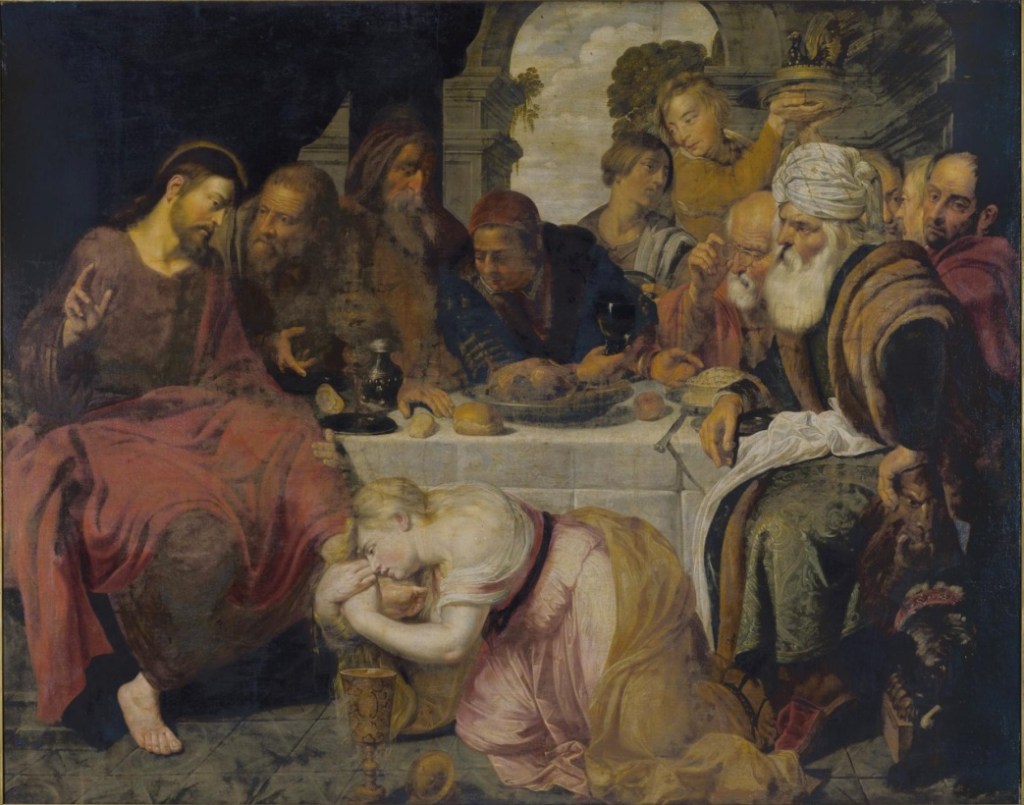
But Jesus said, “Leave her alone! Why are you bothering her? She has done a good deed for Me. For you always have the poor with you, and whenever you want, you can do good to them; but you do not always have Me. She has done what she could; she has anointed My body beforehand for the burial. Truly I say to you, wherever the gospel is preached in the entire world, what this woman has done will also be told in memory of her” (Mark 14:6-9, New American Standard Bible).

Jesus had entered Jerusalem a few days earlier to the applause of a crowd shouting “Hosanna!” The religious leaders were plotting His execution, which would occur within a few days of this moment. Jesus was enjoying one of His last meals with some friends.
Mark wrote that the meal was at the home of Simon the Leper. Luke said it was the home of a Pharisee named Simon. John reported that it was the home of Martha, Mary, and Lazarus. Jesus had previously miraculously raised Lazarus from the dead.
The other Gospels tell us that a woman with a sinful reputation came into the house and poured expensive ointment on Jesus’ feet (some say His head); John specifies that it was Mary, the sister of Lazarus.
I do not believe the Gospels contradict each other; instead, they provide complementary details. Martha, Mary, and Lazarus were disciples of Jesus. Perhaps Simon the Leper was a Pharisee as well as a relative of Mary, Martha, and Lazarus. Maybe he was their father or brother but was not a disciple of Jesus.
Mary’s sacrifice of expensive ointment certainly offended some people’s sensibilities. Pouring that much ointment all over their dinner guest without asking His permission! How foolish! How impulsive! What a waste of money; if she wanted to throw it away, she could have sold it at the local market and given the money to beggars. At least in that way, it would do some good!
Jesus accepted it as worship. We treat worship lightly. Some of us do not want to act too impulsively or extravagantly. We do not think we should sacrifice too much money for the kingdom of God. We don’t want to be fanatics, do we?
For Jesus, though, it was not wasted oil. Mary’s radical worship would be remembered for centuries. In her mind, she was worshiping Him because He had shown her the Father’s love and mercy many times—especially when He raised her brother from the dead. It was an act of extravagant love. To Jesus, though, it was pointing toward His crucifixion and burial.
True worship always points back to Jesus’ death and resurrection and to every drop of love and grace God pours upon us. As He pours blessings over us, let us pour our devotion and worship upon Him. So what if it seems fanatical, extravagant, wasteful, or foolish to others? To God our Savior, our worship is the sweetest aroma in creation.
How do you worship God? Would you consider your worship “sensible” or “extravagant and fanatical”? How can you worship Him more?
Copyright © 2023 Michael E. Lynch. All rights reserved.
 Darkened Glass Reflections