
“To do the wondrous work God had mind to do, he chose me. For God has chosen the foolish things of the world to confound the wise; the mean, contemptible, feeble things of the world to confound the noble and great; so that the grandeur of goodness should proceed from God, and not from his creature; so that no flesh should boast, but that God alone should be honored” [St. Francis of Assisi, from The New Encyclopedia of Christian Quotations, compiled by Mark Water (Grand Rapids, MI: Baker Book House, 2000), p. 514].
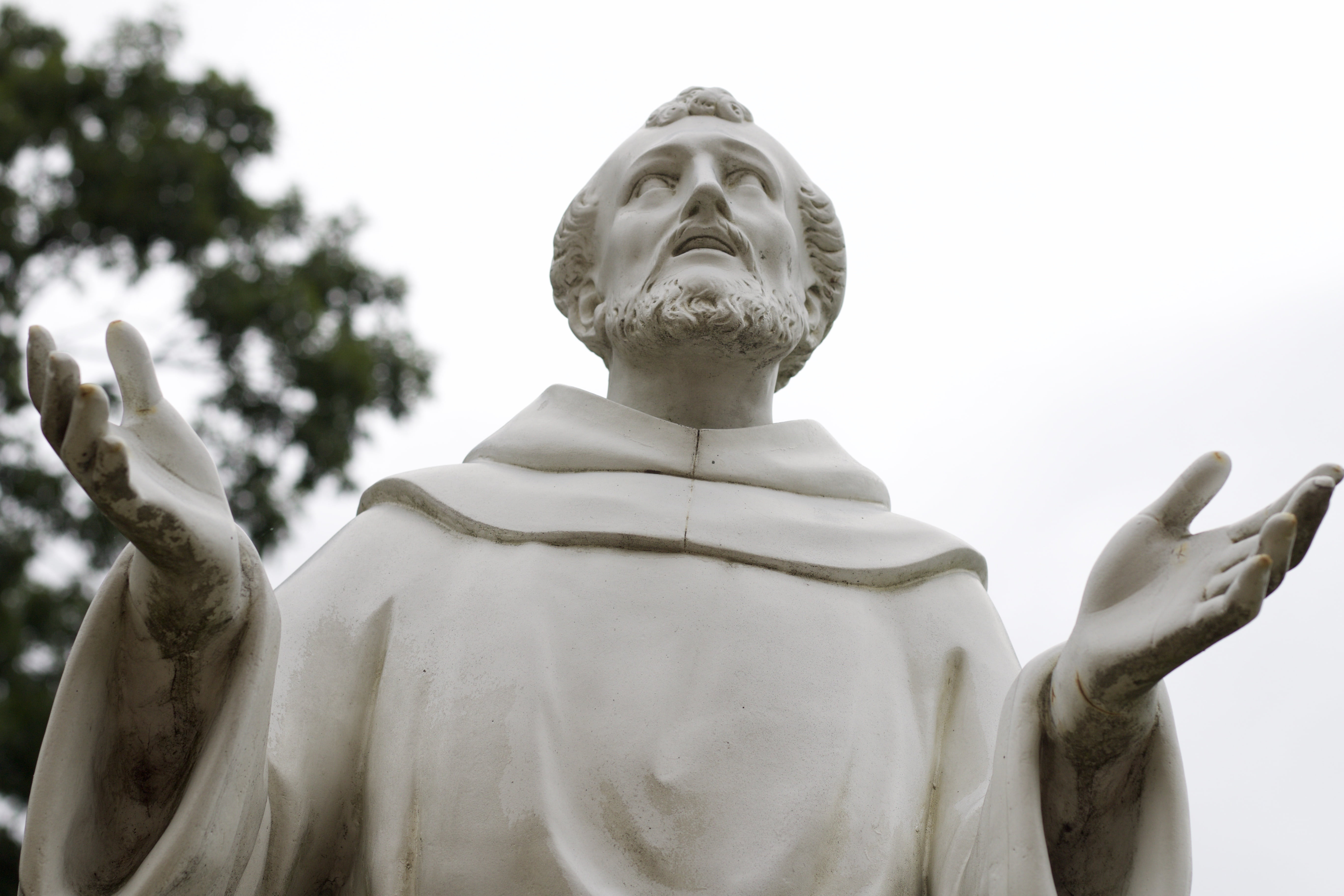
Many churches commemorate St. Francis of Assisi (1182-1226) on this day. He is remembered for many accomplishments, including preaching the Gospel, ministering to the poor and sick, inventing manger scenes (creches) to depict the birth of Christ, and forming the Franciscan monastic order.
Accounts of his life suggest that he was not destined for greatness. Raised in a wealthy family, he had a vision in which God told him to “repair my failing house,” which he initially thought meant repairing the local church. Eventually, he realized it was a call to bring restoration to the church as a whole. He and his followers would preach the Gospel, “using words if necessary,” and ministering in word and deed to share the love of God with whomever they could reach. Several stories from his life suggest a not-so-bright, perhaps eccentric, person with a radical faith, but he inspired others to follow him as he served Christ. As the quote above shows, he believed it was God working through him, not his own skills and gifts, that mattered.
May we all learn from his life and example. Let us decrease, so that Christ’s presence and power may increase in our lives (John 3:30). Let us repent of any desire to exalt ourselves, trying to look like we did anything through our own cleverness or skill to help God advance His kingdom.
“Lord, make us instruments of your peace. Where there is hatred, let us sow love; where there is injury, pardon; where there is discord, union; where there is doubt, faith; where there is despair, hope; where there is darkness, light; where there is sadness, joy. Grant that we may not so much seek to be consoled as to console; to be understood as to understand; to be loved as to love. For it is in giving that we receive; it is in pardoning that we are pardoned; and it is in dying that we are born to eternal life. Amen” (a prayer traditionally attributed to St. Francis of Assisi, from The Book of Common Prayer).
Copyright © 2023 Michael E. Lynch. All rights reserved.
 Darkened Glass Reflections