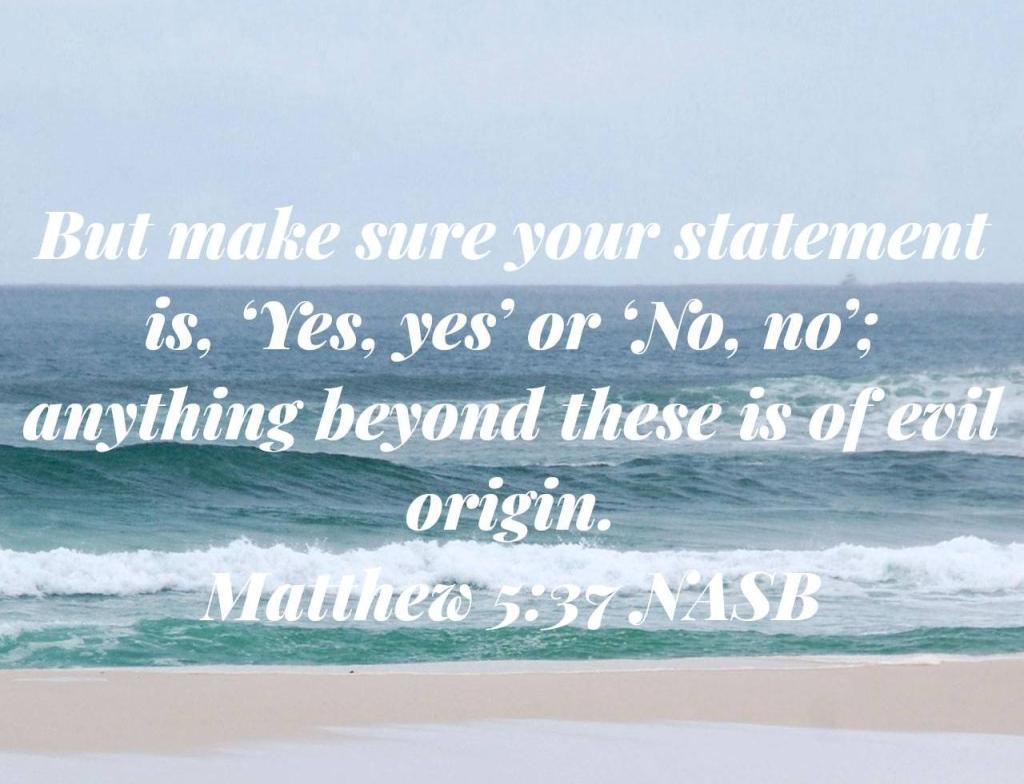
“Again, you have heard that the ancients were told, ‘You shall not make false vows, but shall fulfill your vows to the Lord.’ But I say to you, take no oath at all, neither by heaven, for it is the throne of God, nor by the earth, for it is the footstool of His feet, nor by Jerusalem, for it is the city of the great King. Nor shall you take an oath by your head, for you cannot make a single hair white or black. But make sure your statement is, ‘Yes, yes’ or ‘No, no’; anything beyond these is of evil origin” (Matthew 5:33-37; all Scripture quotations are from the New American Standard Bible).

Jesus did not quote any particular Old Testament verse directly in Matthew 5:33. However, this verse summarizes Old Testament doctrine.
“If a man makes a vow to the Lord, or takes an oath to put himself under a binding obligation, he shall not break his word; he shall act in accordance with everything that comes out of his mouth” (Numbers 30:2).
“When you make a vow to the Lord your God, you shall not delay to pay it, for the Lord your God will certainly require it of you, and it will be a sin for you. However, if you refrain from making vows, it will not be a sin for you. You shall be careful and perform what goes out of your lips, since in fact you have vowed a voluntary offering to the Lord your God, whatever you have promised” (Deuteronomy 23:21-23).
We should also recognize that Jesus was also referencing one of the Ten Commandments: “You shall not take the name of the Lord your God in vain, for the Lord will not leave him unpunished who takes His name in vain” (Exodus 20:7). We usually think this refers to using the name of God as an expletive, but it refers to any way that we can treat God’s name lightly. By the time of Christ, devout Jews would not say the name of God to avoid misusing or even mispronouncing it: they would usually substitute it with some term hinting at Him. For example, instead of saying, “Bless God,” they would say, “Bless the name.” When reading the Scriptures in the synagogue, if they came across the divine name, “YHWH” (pronounced “Yahweh” and translated “Lord” in most English Bibles), they would substitute a generic word for a deity, such as “Elohim.” The New Testament sometimes uses the term “kingdom of heaven” as a synonym for “kingdom of God.”
Yet, in this passage, Jesus suggested that even these practices could be meaningless loopholes. We cannot fool God. He knows what we mean if we say “Gosh darn it.” He also knew what a first-century Jew meant if they made a vow in the name of heaven, earth, Jerusalem, or the altar at the temple. Substitutions do not matter if we do not honor God’s name, holiness, and power.
Despite the holiness of God’s name, people still made oaths in His name. They sought to declare their honesty by invoking God’s name (or a subtle substitute) or vowed to do something in His name. “In the name of God, I will win this battle” (not if the other army is better than yours). “In God’s name, I will run a successful business” (you can make a valiant effort, but market forces might work against you).
Why would we take oaths? Because many people are dishonest. Legal courts require witnesses or parties to a case to swear an oath because they know people lie. If you told the court that everything you said would be the truth, the whole truth, and nothing but the truth, and then intentionally lied to them, you could be charged with perjury.
Oaths are a reminder that we are prone to dishonesty, much like the devil himself, who is the father of lies (John 8:44). Christians are called to walk in the footsteps of Jesus, who is the way, the truth, and the life (John 14:6). Because we follow Him, we should always pursue honesty, integrity, and trustworthiness. When we say “yes,” people should believe that we will do what we say. When we say “no,” they should still be able to trust us. As Christians, we bear a name that connects us with the Son of God. Let us uphold His honor through our lives and character.
“But above all, my brother and sisters, do not swear, either by heaven or by earth or with any other oath; but your yes is to be yes, and your no, no, so that you do not fall under judgment” (James 5:12).
Lord God, Your name is holy, even as You are holy. Inspire us to glorify and honor Your name with our hearts, lips, and lives. May we live with honesty and integrity so that our lives may bring honor to Your holy name. In the glorious name of Jesus Christ our Lord, we pray. Amen.
In what other ways can our lives bring honor to God’s name? How else might we use His name in vain?
Copyright © 2023 Michael E. Lynch. All rights reserved.
 Darkened Glass Reflections