
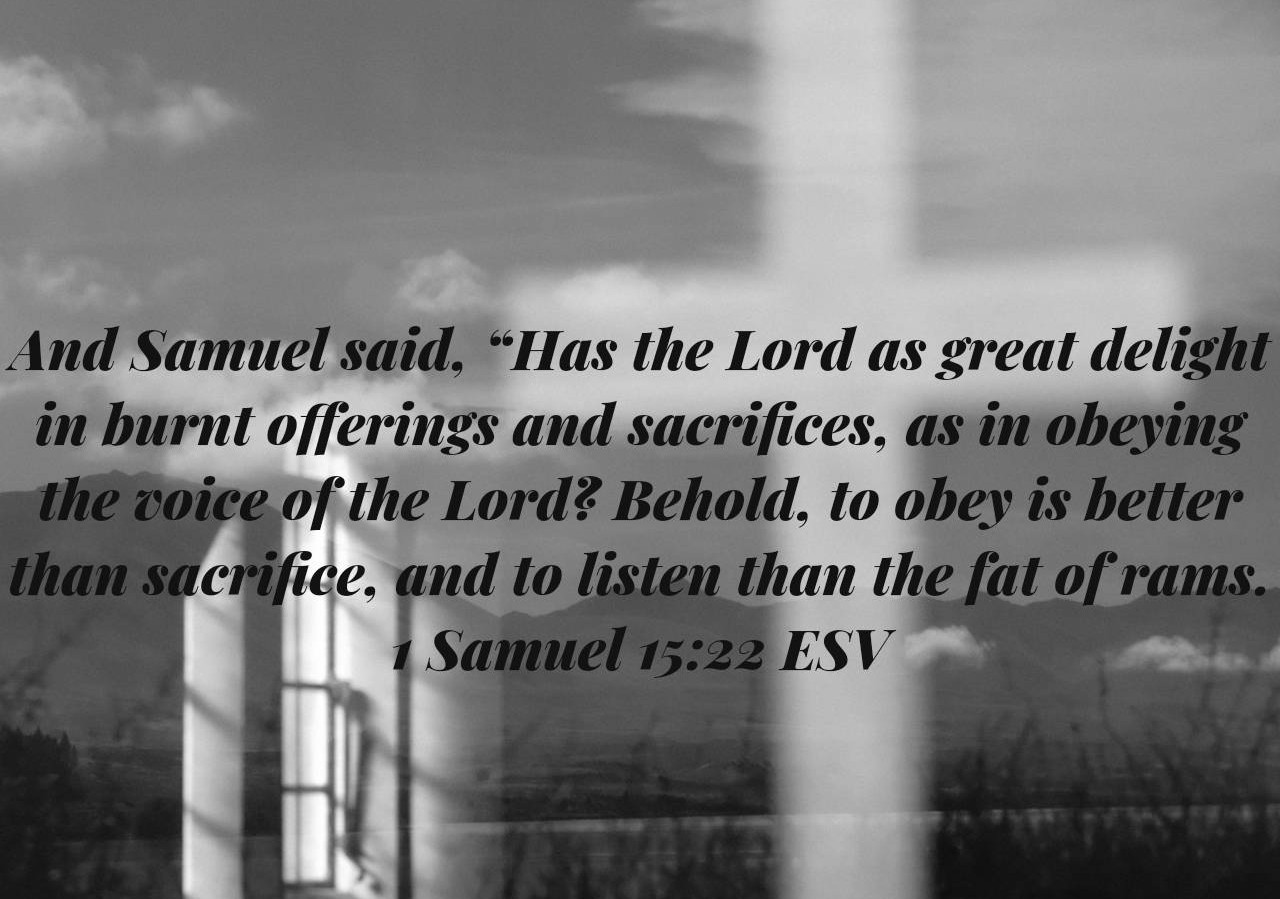
“And Samuel said,
‘Has the Lord as great delight in burnt offerings and sacrifices,
as in obeying the voice of the Lord?
Behold, to obey is better than sacrifice,
and to listen than the fat of rams’” (1 Samuel 15:22, English Standard Version).
“The condition of the heart determines the value of the sacrifice,” according to Warren W. Wiersbe.
First Samuel 9-15 describes the rise and fall of the first king of Israel, Saul. He was chosen by God, with clear instructions that he ruled under God’s authority. God had chosen him through the prophet Samuel; Saul did not reign with unfettered authority.
However, he quickly fell from his position of authority. In 1 Samuel 15, the prophet ordered him to eradicate the Amalekites were had opposed Israel during their wilderness wanderings following their escape from Egypt. It was supposed to be total annihilation: kill all the people and destroy all of their livestock and belongings. However, Saul spared the Amalekite King Agag, taking him as a captive, and brought some of the animals home. As an expression of gratitude to God, he offered some of the animals as sacrifices.
However, God did not want Saul’s sacrifices. He wanted his obedience. Saul had committed an act of half-obedience, which turned his offering into a semi-sacrifice. Samuel the prophet was not pleased; neither was God. It is easy for us to make the same mistakes as Saul.
First, Saul claimed that he fulfilled God’s command when he did only part of it. Saul’s army was supposed to eradicate the entire Amalekite nation that had previously sought to destroy Israel. Saul preserved the king and the best of the animals. Interestingly, several centuries later, the Jewish people would face the threat of extermination as a result of a plot devised by Haman the Agagite (see the book of Esther). Was he a descendant of King Agag? In allowing Agag to live, did Saul unwittingly allow other Amalekites to escape, ensuring that they would remain a threat? Our half-hearted obedience may have unexpected long-term consequences.
Second, Saul blamed the people. When Samuel pointed out the noise of the animals, Saul responded, “They have brought them from the Amalekites…. But the people took of the spoil” (1 Samuel 15:15, 21; emphasis added).
“Everyone else is doing it, so it cannot be too bad. I just went along because I did not want to cause any trouble.” “It’s his fault; he made me do it.” “He/she made me mad!” How often are we willing to say, “I’m responsible for my part in this. Even if other people were wrong, I’m wrong for being part of it or for responding this way”?
Saul even made a religious excuse for his actions. He said the people brought the best animals so they could be sacrificed to God. “I did it for you, Lord.” “I lied on my tax return; now I can make a donation to this ministry.” “I sneak out of work early so I have time to help out at church.” “I am going to this activity (party, bar, movie, etc.) because I can witness to people while I’m there.” God does not want our prayers or religious obligations at the expense of following Him.
As a result of his half-obedience, Saul lost a lot. He lost a part of his character and integrity by lying to the prophet and, in the process, lying to God. One thousand years later, God would strike down a married Christian couple named Ananias and Sapphira when they denied holding back some money while making an offering to the church (Acts 5). It was not about the money. It was about faithfulness and honesty. When God tells us to do something or stop doing something, we should follow Him. We should not make excuses or try to claim that we obeyed Him when we only followed His Word halfway.
Saul also lost his relationship with the prophet Samuel, through whom he had received divine guidance. In the end, he lost his dynasty; God declared that He would seek a man after His own heart. When Saul died, David succeeded him as king.
It is futile to follow God halfway. It is dangerous to worship Him only partially. Let us worship and obey Him with whole hearts. Worship should complete our obedience in godly living, and godly living inspires and empowers our worship, prayer, and all religious and spiritual activities.
Are there areas of your life where you have engaged in half-obedience or semi-sacrifice?
Copyright © 2026 Michael E. Lynch. All rights reserved.
 Darkened Glass Reflections
One response to “Sacrilege of the Semi-Sacrifice (1 Samuel 15:22)”
I pray to learn not to bring sacrifices to a point of losing reality which is forgetting to love and obey God
LikeLike