
When I started college, I was not interested in church or organized religion. My freshman year and the following summer would bring radical changes that altered the course of my life. One spring day began the transformation.
I grew up Roman Catholic, but around the time I started middle school, I stopped attending church. My parents did not force the issue and allowed my three siblings and me to make our own decisions regarding church attendance. At least three of us stopped attending.
I briefly resumed attending Mass around the time I was in twelfth grade. My sister asked me to be her son’s godfather. The priest in our parish simply wanted active practicing Catholics serving as godparents, so I accepted the honor, went to confession, and began going to Mass every Saturday evening. However, that commitment began to dwindle soon after my nephew’s baptism. By the time I started college, I was not attending every weekend. I thought I would resume attending Mass when in college, but the joy of sleeping in on Sunday morning took precedence.
It was not that I was totally hostile to “God” or spirituality. A year earlier, I had watched the movie “Chariots of Fire,” and one statement by the main character, Eric Liddell, had stuck with me. “I know God made me for China {where he would later serve as a missionary}, but He also made me fast. And when I run, I feel His pleasure.” So, I believed one way to find your purpose in life was to discover what God (whoever He or It was) had made you for and go for it.
However, organized religion and traditional Christianity were out of the question for me. I engaged in a spiritual search, studying and reading about New Age, the occult, Buddhism, Hinduism, etc. (I found Buddhism interesting.) However, if friends or classmates mentioned Christianity, I usually responded with sarcasm. (I am now convinced that I became a follower of Christ because I got just enough Christians angry enough at me to start praying for my soul.)
This brings us to April of my freshman year. I was heading to class one morning when I saw a man standing along the path toward the building where I had a few classes. He was handing something out, and it looked like students were taking it. I was about to reach out my hand and accept his gift when I saw the box by his feet, which read: “NEW TESTAMENTS.” He was from the Gideons, a ministry that distributes Bibles; they are most well-known for donating Bibles to place in hotel rooms. He was handing out small green pocket New Testaments, with Psalms and Proverbs at the end.
“No thanks,” I said as I walked by. I had to pass this way a total of six times that day. I could find a longer route to and from classes, but apparently some of his colleagues were at other places on the campus. So, I passed him several times that day, and each time, I got more brazen and hostile as I passed him. On at least one occasion, I said, “No thanks, I don’t need that @^*%.” I probably offered a colorful suggestion for a place on his body in which he could deposit the little book.
After my last class of the day, I had to pass him one last time. For some reason, I decided to just accept the little book. I figured I could always just throw it away when I got back to class. I may not have had any interest in the Bible or Jesus, but I usually preferred to be polite to strangers. So, as I passed him one last time, he was once again holding out the little book. He always seemed to be smiling and pleasant, even to the guy who insulted him.
“Okay, I’ll take it. Thank you,” I said as I accepted the little Bible and placed it in my back pocket (about three inches to the right of where I had suggested he place it inside his person). From there, I went to the dining hall for dinner and then to my dorm room, where I placed it on my desk. (I would not be surprised if I placed it on top of my copy of The Communist Manifesto or the writings of Nostradamus.)
I never did get around to throwing it in the trash.
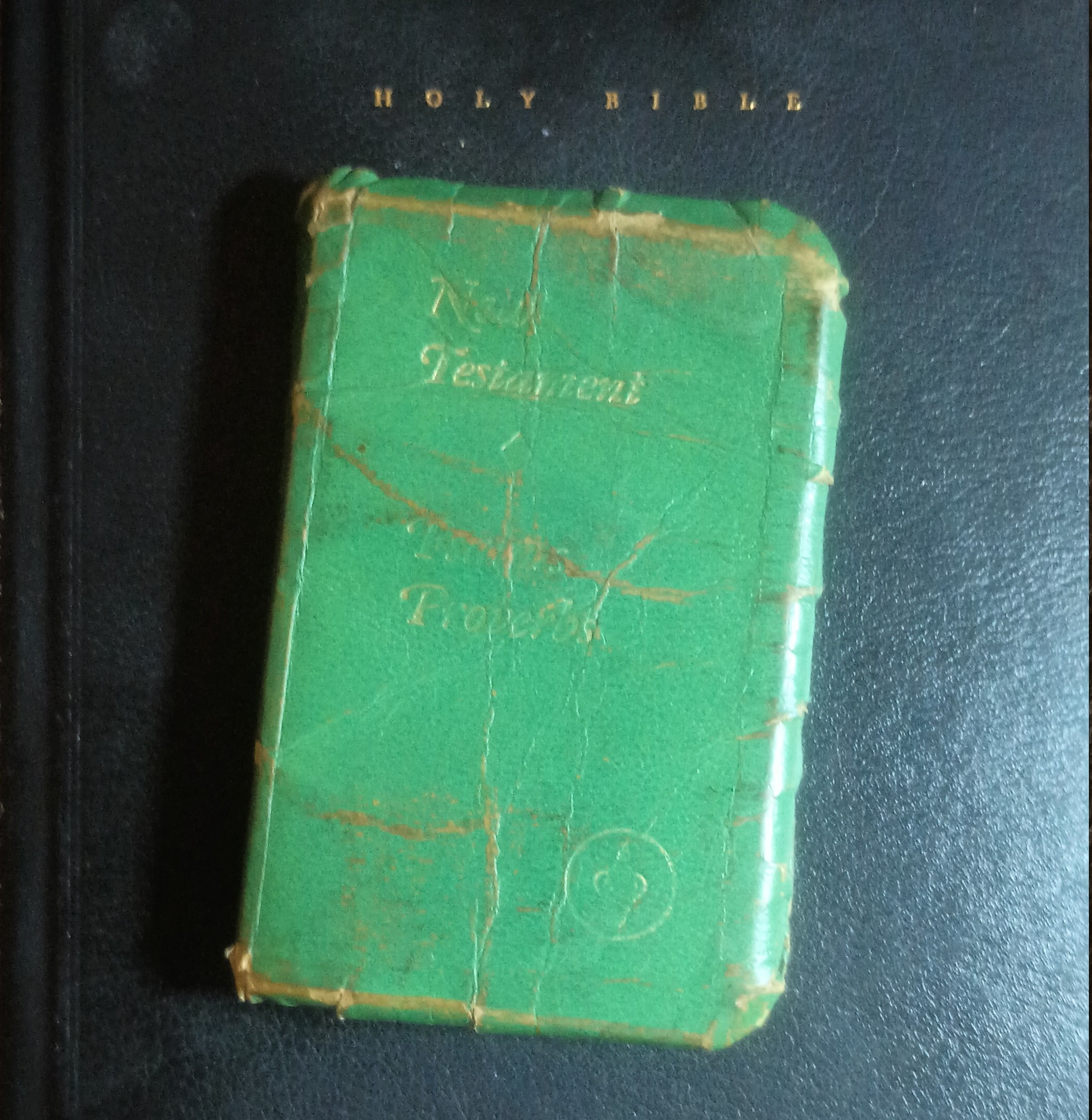
Some time later that evening—perhaps looking for a way to procrastinate mixed with sheer boredom—I decided to start reading the little New Testament. Somehow, despite having plenty to read as a college student, I felt compelled to start reading a book I had actively avoided just a few hours earlier. I started at the beginning: Matthew, chapter 1. I read through several familiar stories; having attended Catholic school as a child, I knew the stories of the Virgin Birth, the visit by the Magi, Jesus’ baptism by John, and His temptation in the wilderness. I did not think I would read much further.
But then, I reached chapter 5, the beginning of the Sermon on the Mount. Some of this was familiar. I had heard the Beatitudes before. Some of the other statements were familiar. But somehow, the entire message opened my eyes. After reading the first seven chapters, I realized something I never knew before: Jesus’ goal in coming to Earth was not to create a new religious organization. His goal was to create a new kind of person. He wanted me to become a new person. Some of His instructions (e.g., most of chapter 5) required superhuman moral strength, and yet He assumed it could be done. I did not know how that could happen, but I believed there was something to it.
That was not my salvation moment, but it set the stage. About two or three months later, my best friend Dean and I were on the boardwalk in my hometown, Long Beach, NY. A group from a nearby church was handing out tracts and sharing the Gospel with whoever would listen, and two young women approached us. The young woman doing most of the talking, named Lynn, mentioned being “born again” and “becoming a new creation” through faith in Jesus Christ. That was the finishing touch. My friend and I prayed with them (right in the middle of the boardwalk), and our lives were forever changed.
A few years later, Lynn told me she was never as nervous about sharing the Gospel as she was when she saw us coming, but she knew she had to speak to us. I am eternally grateful that she did.
That pocket New Testament stayed in my back pocket almost every time I went outdoors over the next few years. I still have it: It is heavily worn, and I no longer read it, but I hold it as a cherished memento of the time that new life was conceived in my soul, leading to spiritual rebirth a few months later.
In John 6:63, Jesus said, “The Spirit gives life;the flesh counts for nothing. The words I have spoken to you—they are full of the Spirit and life” (NIV).[1] I continue to read and study the Bible daily, and it continues to breathe life for me. The words of Scripture are not just ink on a page, clever stories, or wise insights. They breathe forth the Spirit and life of Christ so that He can live in us and we can live eternally in and with Him.
[1]I usually quote the English Standard Version, which has the more accurate translation, “The words that I have spoken to you are spirit and life.” However, for this post, I thought it would be appropriate to quote from the Bible translation that laid the foundation for my walk with Christ.
Copyright © 2026 Michael E. Lynch. All rights reserved.
 Darkened Glass Reflections
2 responses to “The Pocket Bible that Didn’t Get Away”
Interesting to learn more about yourself and how you got converted, having read so many of your blogposts for years!
LikeLiked by 1 person
Thanks, I’m back in seminary and taking a homiletics class, where the instructor wants us to emphasize “telling a story” as a means of preaching the Gospel. It’s not exactly my comfort zone, but I’m going to work on that more than I have in the past.
LikeLike