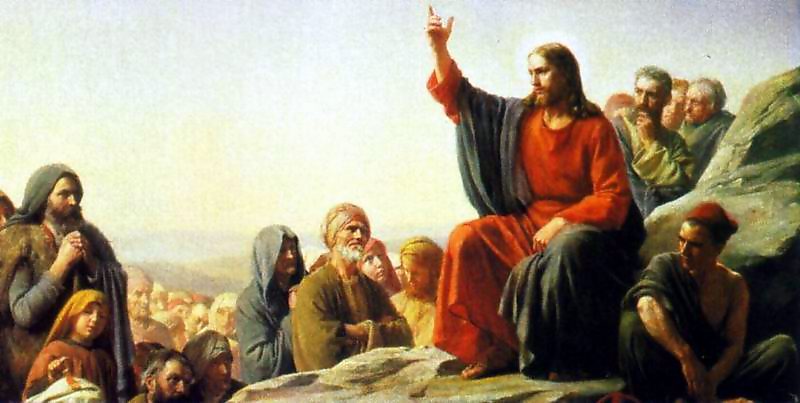
“And when Jesus finished these sayings, the crowds were astonished at his teaching, for he was teaching them as one who had authority, and not as their scribes” (Matthew 7:28-29; all Scripture quotations are from the English Standard Version).

Jesus concluded His Sermon on the Mount. It was most probably a “stock sermon” that He often preached. Since the Lord did not have mass media—no blog, television program, magazines, or newspapers reporting about His speeches—it would have to be repeated often. The people of Bethany would have no idea what He said in Capernaum or Nazareth unless He repeated it. Furthermore, frequent repetition would enable His closest disciples to memorize His teachings and pass them on to future generations.
His sermons always challenge listeners to ask themselves, “What should I do now? How do I respond?”
Jesus’ message has always been counter-cultural. He is not of this world (John 17:14), so His message confronts the entire world—all cultures—with a radical choice. Most of the Sermon on the Mount feel familiar and comfortable. Christians have heard it so often that it just sounds “normal.” We miss how much it confronts our sinfulness and humanity. It reminds us that the ways of God’s kingdom are not normal for this world.
Matthew 7:29 tells us that Jesus taught with authority, and His hearers recognized it. Many rabbis at that time would quote other scribes or rabbis: “Rabbi So-and-So said that this command in the Torah means this.” The audience was expected to accept the present rabbi’s teaching because it agreed with another famous rabbi.
However, Jesus repeatedly said, “But I say to you.” He did not have to rely on another man’s authority. He even claimed the ability to take one step deeper into the Old Testament’s laws, because He was the Word of God who became flesh (John 1:1-4, 14). He could urge His hearers to follow “these words of mine” (Matthew 7:24) because they were the words of God.
Authority demands a response. Most drivers instinctively slow down when they see a police car along the highway. We know that he has the authority to issue a ticket if he catches us speeding. It does not matter what we think of him: He might be ugly, shorter than us, or not sound particularly intelligent. It does not matter: If he is carrying the badge and wearing the uniform, and if he catches us breaking the law, he has the authority to order us to pull over so that he can write a ticket.
Even more so, Jesus has ultimate and permanent authority.
“And Jesus came and said to them, ‘All authority in heaven and on earth has been given to me. Go therefore and make disciples of all nations, baptizing them in the name of the Father and of the Son and of the Holy Spirit, teaching them to observe all that I have commanded you. And behold, I am with you always, to the end of the age’” (Matthew 28:18-20, emphasis added).
Jesus’ authority and the importance of His teaching are eternal and infinite. His message was not only for His first-century Jewish listeners. Nor was it exclusively directed toward the apostles and their contemporaries. No, it was for all of us. He commanded His disciples to teach their followers to observe and obey all that Jesus taught them; their followers were to do the same; and so on, to this day. Jesus’ authority and our commission remain the same until He returns.
What will you do? Will you obey, follow, serve, and love Him with all your heart, soul, mind, and strength? Or will you simply memorize His teachings, quote them, slap them as bumper stickers on your car, and post them online? Will you follow Him?
Lord Jesus, we thank You for Your precious word and all that You taught us. Give us hearts that are eager to hear, know, and obey Your instruction. Forgive us for the times when we choose to ignore Your word or make excuses for disobedience. Continue to speak to us through Your Word. We ask this in Your holy name. Amen.
Which verses or passages in the Sermon on the Mount do you find most challenging or difficult to follow? Are there any in particular that have had a significant impact on your life? Share your thoughts in the comments field below.
Copyright © 2024 Michael E. Lynch. All rights reserved.
 Darkened Glass Reflections