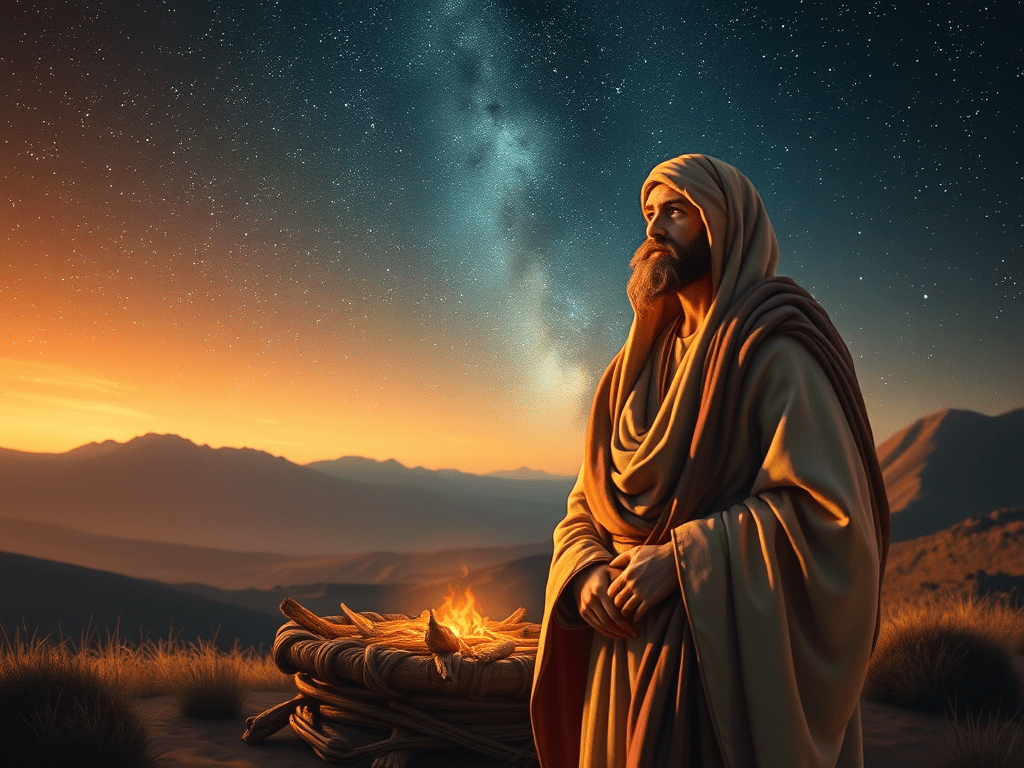
This is part 3 of a three-part series, taken from a paper I wrote for a seminary class on Old Testament Theology. It might be more academic than most articles on Darkened Glass Reflections, but I believe you will find a blessing. You can read part 1 here. Part 2 can be found here.
In the New Testament, St. Paul wrote, “Now the promises were made to Abraham and to his offspring. It does not say, ‘And to offsprings,’ referring to many, but referring to one, ‘And to your offspring,’ who is Christ” (Gal. 3:16; all Sccripture quotations are from the English Standard Version). The promised seed was not the entire nation of Israel, but one person, Jesus. He would bless people from all nations whom God would justify by faith, not only physical descendants of Abraham.
Abraham’s life was a journey of faith as he learned how to trust God in different circumstances, often through trial and error. Trusting God to fulfill the promises took time. God had changed his name from Abram (meaning “exalted father”) to Abraham (“father of a multitude”), yet the promised offspring was slow to come. He had adopted one of his slaves, Eliezer of Damascus, to be his heir.i His aged wife Sarah, discouraged that she had not borne any children, encouraged Abraham to sleep with one of her maidens, Hagar, who bore to a son named Ishmael. As Norman Geisler notes, “Abraham finally had an heir, although it was a result of his own work rather than the fulfillment of God’s promise.”ii This brought conflict to the family; even though it was Sarah’s idea, she came to resent Hagar and Ishmael. This shows us of the danger of relying on our own efforts to obtain God’s blessings instead of trusting Him. Their grandson Jacob would also spend years learning to trust God to fulfill after years of relying on deceit to pursue blessings.
God eventually gave Abraham and Sarah a son of their own. Isaac’s birth was miraculous, as Sarah was 90 years old, well past childbearing age. This reminds us of another miraculous birth; while Sarah was too old to have children, Mary should not have been able to conceive due to her virginity. Nevertheless, both women bore sons conceived as a result of a divine promise and by the power of the Holy Spirit (Gal. 4:23, 29).iii Ishmael became an example of those who are born according to the flesh, in slavery to legalism and sin (Gal. 4:23-30).
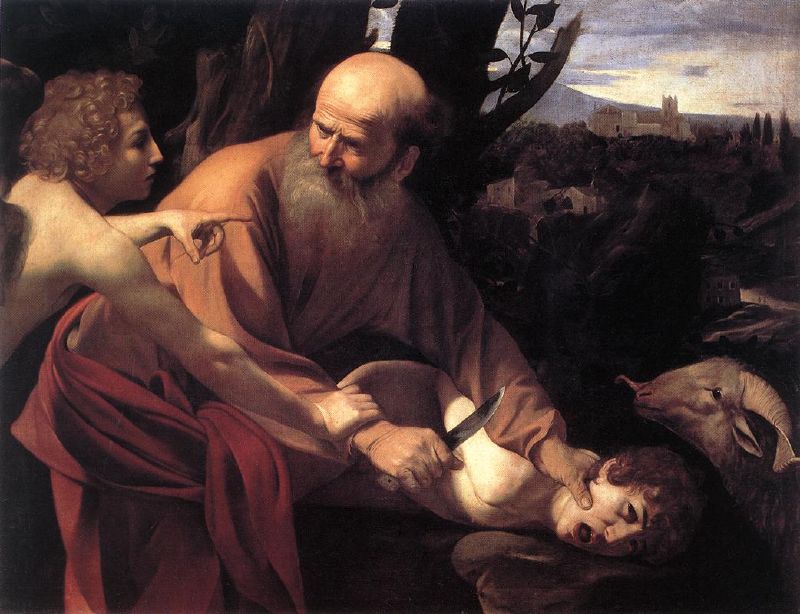
Isaac would also represent Jesus Christ as a sacrificial victim whose life is restored. In Gen. 22, God tested Abraham by ordering him to sacrifice Isaac, the promised heir. Abraham obeyed; it seems that even Isaac willingly obeyed, even though he grew suspicious as they were approaching the mountain without a lamb. Just before Abraham would kill Isaac, the angel of the Lord held back his hand and pointed out a ram who was caught in a nearby thicket. Hebrews 11:19 sees this as a mark of Abraham’s maturing faith and a preview of the resurrection: “He considered that God was able to raise him from the dead, from which, figuratively speaking, he did receive him back.”
The promise would pass to Isaac’s son, Jacob, the second-born of a pair of twins. Isaac preferred the older son, Esau, but Jacob would receive the blessing and birthright, mainly by deceit. His name meant “One who grabs the heal” or “Supplanter,” but the angel of the Lord would eventually rename him Israel, meaning “He struggles with God.” The new name, for both Abram/Abraham and Jacob/Israel, reminds us of the new life and identity we receive when we come to Christ.
Jacob had twelve sons, several of whom received distinct blessings. The promise of the seed would pass to his fourth son, Judah. His descendants would receive the promise of a kingdom: “The scepter shall not depart from Judah, nor the ruler’s staff from between his feet, until tribute comes to him; and to him shall be the obedience of the peoples” (Gen. 49:10). Most English translations say “until Shiloh comes” instead of “until tribute comes to him.” The Revised Standard Version translates it as “until he comes to whom it belongs.” In this sense, Shiloh represents Jesus, the ultimate king whom the Israelites would await.
While not directly related to the themes of “promise” and “seed” we considered so far, it is helpful to consider another recurring feature of Genesis that points to Christ. That is the “angel of the Lord,” who seems to act with God’s authority and to whom people of faith speak as though he is God. Theologians call this a “theophany,” from the Greek for “appearance of God.” A few examples are the following: the angel who appeared to Hagar when she fled from Sarah (Gen. 16:7-14); the three persons who visited Abraham to announce the forthcoming birth of Isaac and pronounce doom upon Sodom and Gomorrah (Gen. 18 and 19); and the angel who wrestled with Jacob and changed his name to Israel (Gen. 32:22-32). While some believe that it was just an ordinary angel, in each case Scripture calls the person “God” at some point in the story. The angel of the Lord looked human, but he acted with divine authority and was believed to be God. It may have been a “christophany,” Jesus Christ Himself temporarily assuming human form to assist His people.
While we cannot preach the full Gospel from Genesis, without the clear description of Jesus Christ—the Incarnate Son of God who died for our sins, rose from the grave, and has ascended to the right hand of the Father—we can find the first glimmers of many of the truths of the New Testament: the promised seed who would conquer Satan, the need to follow Him by faith, and the resurrection power of God among them. The New Testament is not a sudden break from the Old, but a continuation of a commitment by God to guide His people, be with them always, and offer them everlasting life.
iRonald Youngblood, The Heart of the Old Testament: A Survey of Key Theological Terms, 2nd edition (Grand Rapids, MI: Baker Academic, 1998), pp. 25-26.
iiNorman L. Geisler, A Popular Survey of the Old Testament (Grand Rapids, MI: Baker Books, 1977), p. 46.
iiiYoungblood, p. 27.
Copyright © 2026 Michael E. Lynch. All rights reserved.
 Darkened Glass Reflections