The following is based on a sermon I delivered in a Hermeneutics and Homiletics class at the CEC Northeast Diocese Seminary on April 18, 2026. This is the first of two parts.
“And in his teaching he said, ‘Beware of the scribes, who like to walk around in long robes and like greetings in the marketplaces and have the best seats in the synagogues and the places of honor at feasts, who devour widows’ houses and for a pretense make long prayers. They will receive the greater condemnation.’
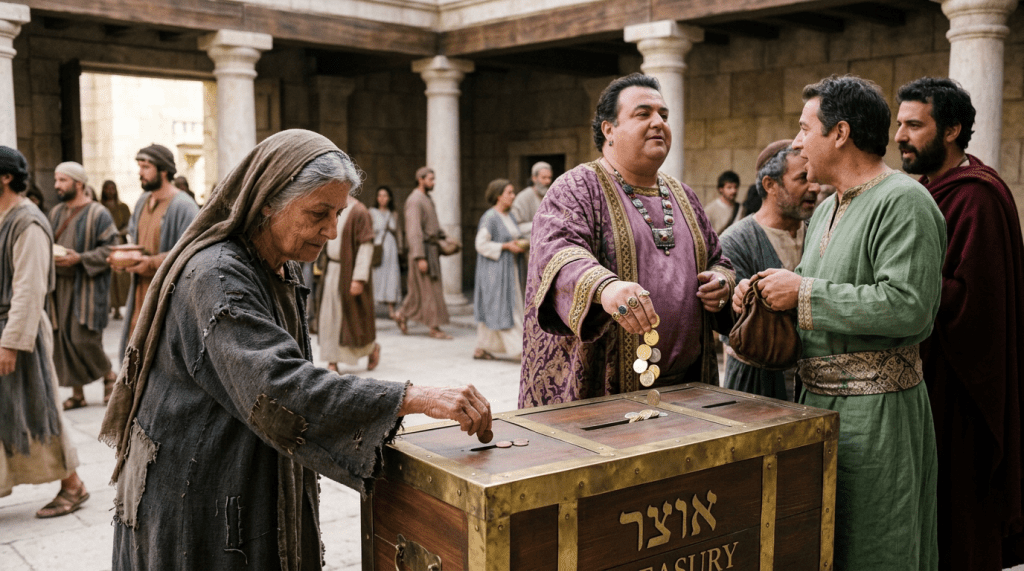
And he sat down opposite the treasury and watched the people putting money into the offering box. Many rich people put in large sums. And a poor widow came and put in two small copper coins, which make a penny. And he called his disciples to him and said to them, ‘Truly, I say to you, this poor widow has put in more than all those who are contributing to the offering box. For they all contributed out of their abundance, but she out of her poverty has put in everything she had, all she had to live on’” (Mark 12:38-44; all Scripture quotations are from the English Standard Version).
This passage has two parts. Verses 38-40 focus in on one of Jesus’ seven woes against the scribes and Pharisees. You can read all of the woes in Matthew 23:1-36, but Mark zeroes in on just one of them—this rebuke of the ostentatious self-righteousness of the scribes. In the middle of it, He points out how the scribes would “devour widows’ houses.”
The second part, Mark 12:41-44, calls our attention to one widow and her tiny offering. Mark wants us to see, from Christ’s perspective, the contrast between many of the scribes and this widow.
Jesus is sitting in the outer court of the temple, which is also called the Court of Women. This is where the offering boxes were located; any Jew could come in here and donate money for temple maintenance. Only Jewish men could go further into the temple. Having just pronounced His woes against the scribes and Pharisees, Jesus now sits down and watches people make their donations. One person grabs His attention. For a few moments, this woman becomes the only person that matters to the Lord.
She is a widow. In a society where women did not have equal rights and were unable to make a living on their own, she was particularly vulnerable. It seems like she is coming alone, which would suggest that she did not have any close relatives to care for her.
The Old Testament provided guidelines for caring for widows. One rule required the late husband’s next of kin to marry a childless widow and raise children in the deceased’s name. (The book of Ruth discusses this role, often referred to as the kinsman-redeemer.) By Jesus’ time, Jewish scribes had come up with a way to help such vulnerable widows. Scribes—who were among the most educated and respected people in Jewish culture—would serve as trustees or administrators of a widow’s estate. Thanks to their knowledge of the Torah, education, and status, they could fulfill several roles that an attorney might carry out nowadays, and this was one of them. It sounds like a good deal, at least in theory. The widow’s valuables might even be stored in a room in the temple’s treasury. Her home might be an easy target for thieves, but the temple’s treasury area had great security. Thieves won’t break in and steal. The scribe would receive a percentage of her wealth as compensation for his services.
However, as you can imagine, it did not always work out as promised, and we can see why Jesus accused them of devouring widows’ houses. The scribe might charge more than necessary; he might even pilfer something that was not part of the agreement. Worst of all, he might not consider the widow’s needs to be as important as some of his other jobs: She might need money to buy food right now, but he might have “more important” things to worry about. After all, “Passover’s coming. I’m a scribe. I have important things to do at the temple and synagogue. You’re just going to have to wait. It’s not my problem that you’re hungry!”
So, this is the scene. Jesus and His disciples would be aware that this sort of arrangement existed. They might even be thinking, “Her stuff is probably in here. Where’s her trustee? For all we know, it might be that one scribe we saw five minutes ago, heading into the Court of Men where this woman cannot come near him.”
Despite her poverty, she continues to donate faithfully to the house of the Lord. Her other possessions might already be in here, but she still brings her last two coins. Perhaps she has always faithfully given a tithe to the Lord. Even though it is her last two coins, if she owes it as part of her tithe, she is giving it to the Lord. Even though she is a victim of society—the victim of greed, abuse of power, and injustice—and even though life has robbed her of her husband and all earthly security, she gives her last little bit of money.
Jesus is impressed, but His disciples are not. Jesus looked at offerings very differently than they did. On another occasion (Mark 14:3-9), they criticized Mary of Bethany when she “wasted” ointment on Jesus’ feet. Mary’s act of worship sounded like a waste of money: “We could have sold this ointment, collected a year’s worth of wages, and given it to the poor: you know, Lord, like that widow we saw at the temple.” They saw waste then. Likewise, the widow’s offering seemed trivial, inconsequential, and irrelevant.
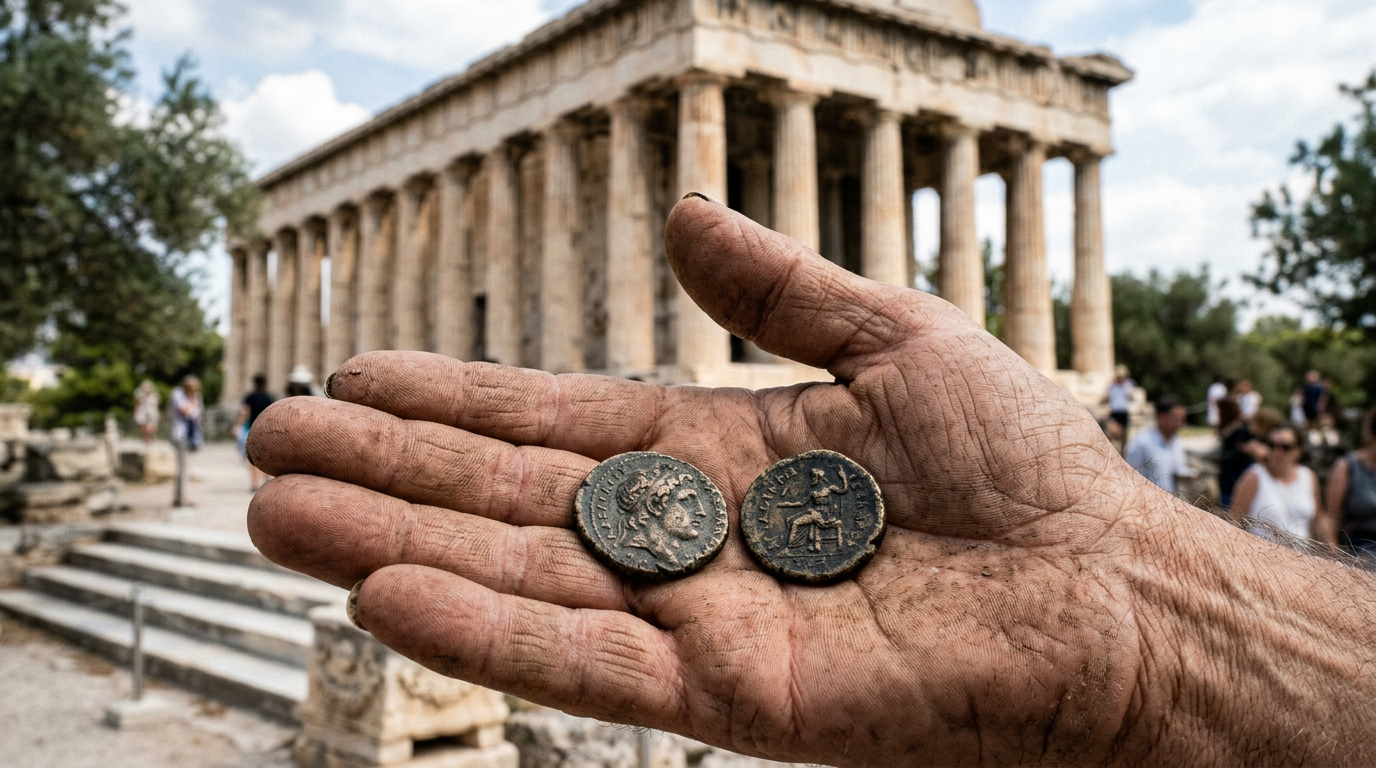
What is this widow’s offering even worth? It equaled about 1/50 of an average laborer’s daily wages. This would be like one of us throwing a $5 bill into the offering basket. The disciples were probably thinking, “How can this little offering matter? Have you seen these elaborate buildings? Don’t you know how much money it costs to purchase incense for the altar, feed the sacrificial lambs, or maintain the facilities around here? Nobody is going to notice what this poor old lady just threw in the offering box!”
While the disciples see a small amount of money—barely enough to pay for the high priest’s morning cup of coffee—Jesus sees something else. He sees the sacrifices, the elaborate buildings, and all of that. He also knows it will not last forever. Jesus calls His disciples to see beyond the $5 offering to what it meant to the widow, and to His heavenly Father.
The English Standard Version tells us that “she out of her poverty has put in everything she had, all she had to live on.” The Greek is even more blunt. It says she gave “her entire life.” This is what impresses Jesus. He already knew that in a few days He would give His entire life for the sins of the world; now, He sees a poor widow giving her entire life to worship God. The donation of money expressed the surrender of her entire life
For all we know, the scribe who was managing the widow’s finances might have made an offering earlier that day. It might even have looked impressive; maybe the temple officials issued a press release about it. He still had extra money. The widow, however, gave everything she had. Hers was a sacrifice, an act of total devotion. God now had everything; she had to trust Him fully to take care of her.
This is the first part of the sermon. Part 2 appears here.
Copyright © 2026 Michael E. Lynch. All rights reserved.


2 responses to “The Widow’s Mite: Giving Her Entire Life (Mark 12:38-44)”
🙏 ❤️ ❤️
LikeLike
[…] The following is the second part of a series based on a sermon I delivered in a Hermeneutics and Homiletics class at the CEC Northeast Diocese Seminary on April 18, 2026. You can read Part 1 here. […]
LikeLike